The Eternal Cycle of Return: Embracing Our Shared Source
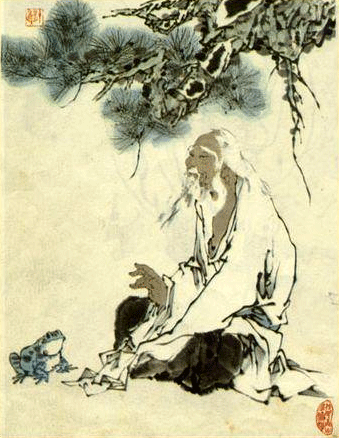
Chuang Tzu's assertion that "All things in creation come from one source and return to one source" invites us to reflect on the interconnectedness of existence. This profound statement encapsulates the essence of life’s cyclical nature, urging us to recognize that every being and phenomenon is part of a greater whole. Understanding this principle can transform our perception of individuality and separateness, fostering a sense of unity and belonging in a world often marked by division.
At its core, this quote speaks to the fundamental Taoist belief in the unity of all things. It challenges us to consider the origins of our existence and the inevitable journey back to that origin. In a society that often prioritizes materialism and individual achievement, Chuang Tzu's wisdom serves as a gentle reminder of the deeper currents that bind us together, encouraging us to cultivate awareness of our shared source and the return to it.
The image / the metaphor
The imagery in Chuang Tzu's quote evokes a sense of flow and continuity, suggesting that creation is not a series of isolated events but rather a seamless tapestry woven from a singular thread. The verbs "come" and "return" imply movement, a dynamic process that transcends static existence. This notion of a source—an origin from which all things emerge—invites contemplation on the nature of existence itself, hinting at a cosmic rhythm that governs life.
Diving deeper into the metaphor, we can envision this source as a vast ocean from which countless rivers flow, each representing a unique life or experience. While the rivers may meander and diverge, they ultimately find their way back to the ocean, symbolizing the inevitable return to unity. This metaphor not only highlights the transient nature of individual existence but also emphasizes the importance of recognizing our shared essence, fostering compassion and understanding among all beings.
In the speaker's tradition
Chuang Tzu's insights are deeply rooted in the Taoist tradition, which emphasizes the interconnectedness of all life and the importance of aligning oneself with the Tao, or the Way. This concept resonates with ideas such as dharma in Hinduism, which speaks to the inherent order and purpose of the universe, and kenosis in Christian mysticism, which refers to the self-emptying of one's will to align with divine will. In this light, Chuang Tzu's quote serves as a reminder that our individual journeys are part of a larger cosmic dance, where each step is imbued with meaning.
Furthermore, the text of the Zhuangzi itself offers rich narratives that illustrate the fluidity of identity and the importance of embracing change. For instance, the story of the butterfly dream challenges the boundaries between reality and illusion, prompting readers to question the nature of existence. This aligns beautifully with the idea that all things originate from and return to a singular source, inviting us to explore the depths of our own consciousness and the nature of our experiences.
Living the teaching
In our modern lives, the teaching of Chuang Tzu can manifest in various ways. Consider a moment of frustration when faced with a challenging situation at work. Instead of viewing this challenge as an isolated event, one can reflect on how it is part of a larger journey of growth and learning. By recognizing that difficulties often arise from the same source as our strengths and successes, we can cultivate resilience and a sense of purpose, transforming obstacles into opportunities for deeper understanding.
Additionally, this teaching can profoundly impact our relationships. When conflicts arise with loved ones, it is easy to become entrenched in feelings of separation and misunderstanding. However, by remembering that all beings share a common origin, we can approach these moments with empathy and compassion. This perspective encourages us to seek reconciliation and connection, fostering deeper bonds that honor our shared humanity and the cyclical nature of our interactions.
A reflection
As we contemplate Chuang Tzu's wisdom, we are invited to ask ourselves: How can I recognize the interconnectedness of all things in my daily life? This question encourages us to explore the ways in which our actions, thoughts, and relationships are intertwined with the greater tapestry of existence. By embracing this inquiry, we can cultivate a deeper awareness of our shared source and the beauty of our return to it.



Join the BrightStar Community
Stay connected with daily inspiration, event announcements, and community wisdom