The Freedom of Letting Go: Chuang Tzu's Path to Peace
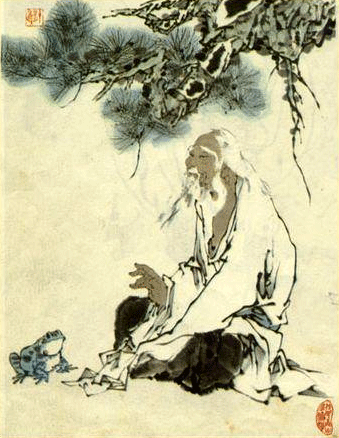
Chuang Tzu's assertion that "He who can let his thoughts go finds peace" invites us into a profound exploration of the relationship between our thoughts and our inner tranquility. In a world that often equates busyness with value, this quote challenges us to reconsider the weight we place on our mental chatter. The stakes are high; our incessant thoughts can lead to anxiety and discontent, while the ability to release them opens the door to a more serene existence. This teaching is not merely philosophical; it is a practical guide to navigating the complexities of life with grace.
Delving deeper, we recognize that the act of letting go is not an abandonment of thought but rather a transformation of our relationship with it. Chuang Tzu encourages us to cultivate a sense of detachment, allowing thoughts to flow without clinging to them. This practice of non-attachment is essential for achieving peace, as it liberates us from the burdens of overthinking and the incessant need for control. In this light, the quote becomes a beacon for those seeking a more harmonious way of being, one that resonates with the core principles of Taoism.
The image / the metaphor
At its core, Chuang Tzu's quote employs the imagery of release, suggesting a gentle yet profound act of letting thoughts drift away like leaves on a stream. The verb "let go" evokes a sense of ease and fluidity, contrasting sharply with the rigidity often associated with holding onto thoughts. This imagery invites us to envision a state of mind where thoughts are not shackles but rather ephemeral visitors, passing through our consciousness without leaving a trace. The felt sense of this release is one of lightness, as if burdens are lifted and clarity emerges.
Going deeper into the metaphor, we can see that letting go is akin to the practice of mindfulness, where one observes thoughts without judgment or attachment. This act of observation transforms our experience; instead of being ensnared by our thoughts, we become the witness, creating space for peace to enter. The metaphor of flowing water, a common symbol in Taoist philosophy, resonates here as well, illustrating how thoughts can be allowed to ebb and flow without disrupting the stillness of the mind. In this way, Chuang Tzu's wisdom becomes a guide for navigating the turbulent waters of our inner lives.
In the speaker's tradition
Chuang Tzu's teachings are deeply rooted in the Taoist tradition, which emphasizes harmony with the Tao, or the fundamental nature of the universe. Central to this philosophy is the concept of wu wei, or "non-action," which encourages individuals to align with the natural flow of life rather than resist it. This principle resonates with the idea of letting go; by relinquishing our tight grip on thoughts and outcomes, we allow ourselves to move in harmony with the world around us. The practice of letting go is not merely a personal endeavor but a spiritual one, inviting us to embrace the interconnectedness of all things.
In the text of the Zhuangzi, we find numerous anecdotes illustrating the value of surrendering to the flow of life. One such story involves a skilled butcher who, through years of practice, learns to cut meat with such ease that he moves in perfect harmony with the animal's natural structure. This tale serves as a metaphor for the peace that arises when we let go of rigid thinking and allow ourselves to be guided by intuition and experience. Just as the butcher finds freedom in his craft, so too can we find peace in the act of releasing our thoughts.
Living the teaching
Consider a modern scenario where this teaching can be applied: a busy professional overwhelmed by the demands of work and life. Each day, the mind races with to-do lists, deadlines, and expectations, creating a cycle of stress and anxiety. By embracing Chuang Tzu's wisdom, this individual can practice letting go of these incessant thoughts, perhaps through mindfulness meditation or simple breathing exercises. In doing so, they create a mental space that allows for clarity and calm, transforming their experience of work from one of pressure to one of purpose.
Another application of this teaching might arise in the context of personal relationships. Imagine a moment of conflict where emotions run high, and thoughts spiral into accusations or blame. By practicing the art of letting go, individuals can step back from their thoughts, allowing for a more compassionate response. This shift not only fosters understanding but also nurtures a deeper connection between partners. In both scenarios, the act of releasing thoughts becomes a powerful tool for cultivating peace and harmony in everyday life.
A reflection
As we reflect on Chuang Tzu's profound insight, we are invited to consider: What thoughts am I holding onto that prevent me from experiencing peace? This question encourages us to engage in a contemplative practice, examining the mental patterns that shape our lives. By identifying and releasing these thoughts, we can begin to experience the tranquility that comes from living in alignment with the flow of existence. In this way, Chuang Tzu's teaching becomes not just a philosophical concept but a lived reality, guiding us toward a more peaceful and liberated way of being.



Join the BrightStar Community
Stay connected with daily inspiration, event announcements, and community wisdom