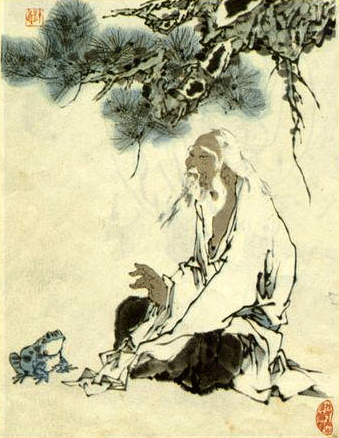
The Wisdom Beyond Division
Chuang Tzu's assertion that "petty wisdom dissects" invites us to reflect on the nature of wisdom itself. In this statement, he suggests that a narrow, superficial understanding of the world leads to fragmentation and division, rather than unity and insight. This matters profoundly in our contemporary lives, where the tendency to categorize and dissect experiences can often obscure the deeper truths that connect us all. By recognizing the limitations of such "petty wisdom," we are encouraged to seek a more holistic understanding of existence.
Moreover, Chuang Tzu's words serve as a reminder of the importance of perception in shaping our reality. When we approach life with a mindset that prioritizes analysis over synthesis, we risk losing sight of the interconnectedness of all things. This division not only affects our personal understanding but also influences our relationships with others and the world around us. Thus, the call to transcend petty wisdom becomes a call to embrace a more profound, integrative approach to life.
The image / the metaphor
At its core, the phrase "petty wisdom dissects" conjures an image of a scalpel slicing through the fabric of reality, revealing its components but failing to capture the essence of the whole. The verb "dissects" implies a clinical, detached approach, one that prioritizes analysis over experience. This imagery evokes a sense of loss, as the beauty and complexity of life are reduced to mere parts, stripped of their context and meaning. In this way, Chuang Tzu warns us against the dangers of over-intellectualization, urging us to recognize the limitations of a fragmented perspective.
Diving deeper into the metaphor, we can see that "petty wisdom" represents a mindset that thrives on division and separation. It is a wisdom that seeks to categorize, label, and compartmentalize, often leading to misunderstandings and conflict. In contrast, true wisdom, as Chuang Tzu suggests, invites us to embrace the wholeness of existence, recognizing that the interconnectedness of all things transcends the boundaries we often impose. This deeper understanding encourages us to cultivate a sense of unity rather than division, fostering compassion and empathy in our interactions with others.
In the speaker's tradition
Chuang Tzu's teachings are deeply rooted in the Taoist tradition, which emphasizes the importance of harmony, balance, and the natural flow of life. Central to this philosophy is the concept of "wu wei," or effortless action, which encourages individuals to align themselves with the natural rhythms of existence rather than impose their will upon it. In this context, "petty wisdom" can be seen as a deviation from the Tao, leading to a life characterized by struggle and disconnection. By recognizing the limitations of such wisdom, we can begin to cultivate a more profound understanding of our place within the cosmos.
In the text of the Zhuangzi, we find numerous anecdotes and parables that illustrate the folly of rigid thinking and the value of embracing the unknown. For instance, the story of the "butterfly dream" serves as a poignant reminder of the fluidity of identity and perception, challenging the distinctions we often draw between self and other, reality and illusion. This narrative aligns with Chuang Tzu's assertion that true wisdom transcends the dissection of experience, inviting us to embrace the mystery and wonder of life.
Living the teaching
Consider a modern scenario where the teaching of Chuang Tzu's quote becomes particularly relevant: the realm of social media. In an age where information is dissected and analyzed at lightning speed, individuals often find themselves caught in a web of division and conflict. The tendency to categorize opinions and experiences can lead to a fragmented understanding of complex issues, fostering an environment where empathy is overshadowed by judgment. By recognizing the limitations of this "petty wisdom," we can strive to engage with others in a more holistic manner, seeking to understand rather than simply dissect.
In the context of personal relationships, Chuang Tzu's teaching can also illuminate the dynamics of communication. When conflicts arise, it is easy to fall into the trap of dissecting each other's words and actions, leading to misunderstandings and resentment. Instead, by embracing a more integrative approach, we can seek to understand the underlying emotions and motivations that drive our interactions. This shift in perspective allows for deeper connections and fosters a sense of unity, reminding us that our shared humanity transcends the divisions we often create.
A reflection
As we contemplate Chuang Tzu's assertion that "petty wisdom dissects," we are invited to reflect on our own perceptions and the ways in which we engage with the world. Are there areas in our lives where we tend to dissect rather than embrace the whole? In what ways can we cultivate a deeper understanding of interconnectedness, both within ourselves and in our relationships with others? These questions serve as a guide for our journey toward a more profound wisdom, one that honors the complexity and beauty of existence.



Join the BrightStar Community
Stay connected with daily inspiration, event announcements, and community wisdom